The Complete Pattaya Baht Bus Guide: Fares, Routes & Avoiding Scams
If you’ve just landed in Pattaya, the typical Pattaya Baht Bus has a bolted-on roof and two bench seats in the back. The Thais call them songthaews, which roughly means “two rows”, and that’s exactly what they are. They run set routes around town, pick up anyone who waves, drop you anywhere along the way and cost less than a can of Chang. I’ve been riding them since 2006, and they’re still the cheapest and quickest way to get between your hotel, the beach and the bars.
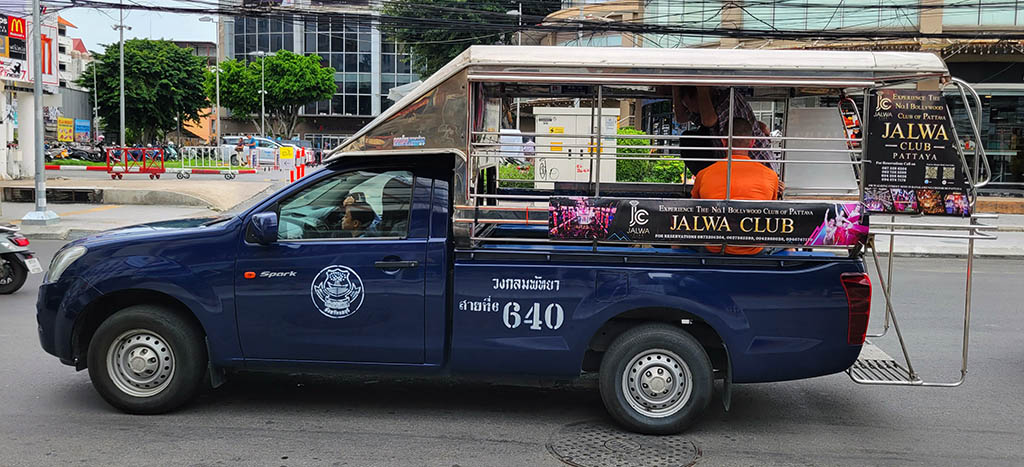
They can look a bit daunting the first time. There’s no timetable, no route numbers, no bus stops and the driver rarely speaks English. You’ll get the hang of all that in a day. The thing to get right from the start is the one mistake nearly every first-timer makes, because that’s what turns a 15 Baht ride into a 200 Baht one.
The Golden Rule: Never Ask the Driver How Much
You walk up to a baht bus parked at the kerb, lean in the window and ask “How much to Walking Street?”
As soon as you ask, you’ve stopped being a passenger and become a customer. A driver sitting parked and empty isn’t running the route. He’s waiting for someone to ask him exactly that. You’ll be quoted somewhere between 150 – 300 Baht, and if you agree the truck is yours for a private run. That’s a charter. It’s a legitimate service and there are times it’s worth paying for, but it’s not what you were after and it costs ten to twenty times the shared fare.
If you do want a private ride, open Grab or Bolt on your phone instead. Either one will nearly always come in cheaper than a baht bus charter, the price is shown before you book and there’s nothing to haggle over. The catch is that you may have a short wait while a driver accepts the job and makes his way to you, particularly when it’s busy.
The baht buses lined up outside the big beachfront hotels, around Central Festival and near Walking Street at closing time are mostly after charters. The rule of thumb I give every mate who visits is simple enough. A truck that’s stopped and empty is a taxi (exceptions are noted under the route descriptions). A truck that’s moving with people in the back is a bus.
The right way to do it:
- Work out which direction you need to go before you leave the hotel
- Stand at the kerb on a road the trucks run along, facing the oncoming traffic
- Flag down a truck that’s already moving your way, ideally one with a few people in the back
- Climb in the back without saying a word to the driver
- Pay when you get off
Act like you’ve done it a hundred times and nobody will treat you any differently.
Baht Bus Fares in 2026
| Route | Fare (October 2026) |
|---|---|
| Beach Road and Second Road loop | 15 Baht |
| Soi Buakhao | 15 Baht |
| Pattaya to Jomtien | 20 Baht |
| Baht bus charter (private run within town) | 150 – 300 Baht, negotiated |
| Grab or Bolt (private ride within town) | Usually less than a charter, price shown in the app |
Shared fares are per person, per ride, paid in cash when you get off. Prices checked November 2026.
Fares have crept up over the years. It was 10 Baht a ride when I first started coming here and plenty of older guides online still quote that. Pay the current fare and don’t argue the toss.
Carry small money. A pocket of 10 Baht coins and a couple of 20 Baht notes covers any shared ride in town. Handing a driver a 500 or a 1,000 for a 15 Baht trip is asking for trouble. He may not have change, he may take his time finding it and every now and then the change comes back a bit lighter than it should. I break big notes at 7-Eleven whenever I buy something and keep the coins aside for baht buses.
Late at night some drivers want a bit more, particularly picking up around the bottom end of Beach Road after the bars close. If it’s an extra 5 Baht at 2 am I just pay it and save myself the conversation.
How a Ride Actually Works
Flagging One Down
Stand at the edge of the road and hold your arm out, palm down, with a small wave. That’s how Thais hail anything. A driver who’s going to stop will usually give a short toot and pull in a little past you. If a truck pulls over and the driver leans across to ask where you’re going, he’s offering a charter. Shake your head, smile and wait for the next one. On the main loop, there’s usually another along within a minute or two during the day.
The city has tried to restrict where baht buses stop. They painted bright bays on the road and issued statements saying they could not stop anywhere else. Predictably, the order was ignored. That said you should still consider if you are comfortable stopping on before flagging it down.
Getting In
You climb in from the back using the step and the grab rail. Get in and sit down quickly, because drivers often pull away before you’ve found a seat. When it’s full you’ll see people standing on the back step, hanging onto the rail. Plenty of people do it, but after a few beers I’d rather wait for the next truck. People fooling around have fallen off.
Watching Where You’re Going
Keep half an eye on the street. If the truck turns off the route you expected, get off at the next chance and flag another. You’ll pay a second fare, which beats ending up out on Sukhumvit Road with a driver who has turned your ride into a charter you never agreed to.
Stopping
There’s a buzzer button on the roof of the cabin, usually along the rail above the benches. Press it as your stop comes up and the driver will pull over at the next spot he can, often 20 – 50 metres further on, so press it a bit early rather than a bit late. Nobody expects you to say anything.
Paying
Step down off the back, walk up the kerb side of the truck to the front passenger window and pass your money through. Thailand drives on the left, so the kerb side keeps you out of the traffic. Don’t wander round to the driver’s window on the road side. Hand over the right amount, wait for change if you need it and walk off. Most drivers don’t even look at it.
The Routes a Newbie Actually Needs
There are more routes than these, but with these three you can get to nearly everything a first visit involves.
The Beach Road and Second Road Loop
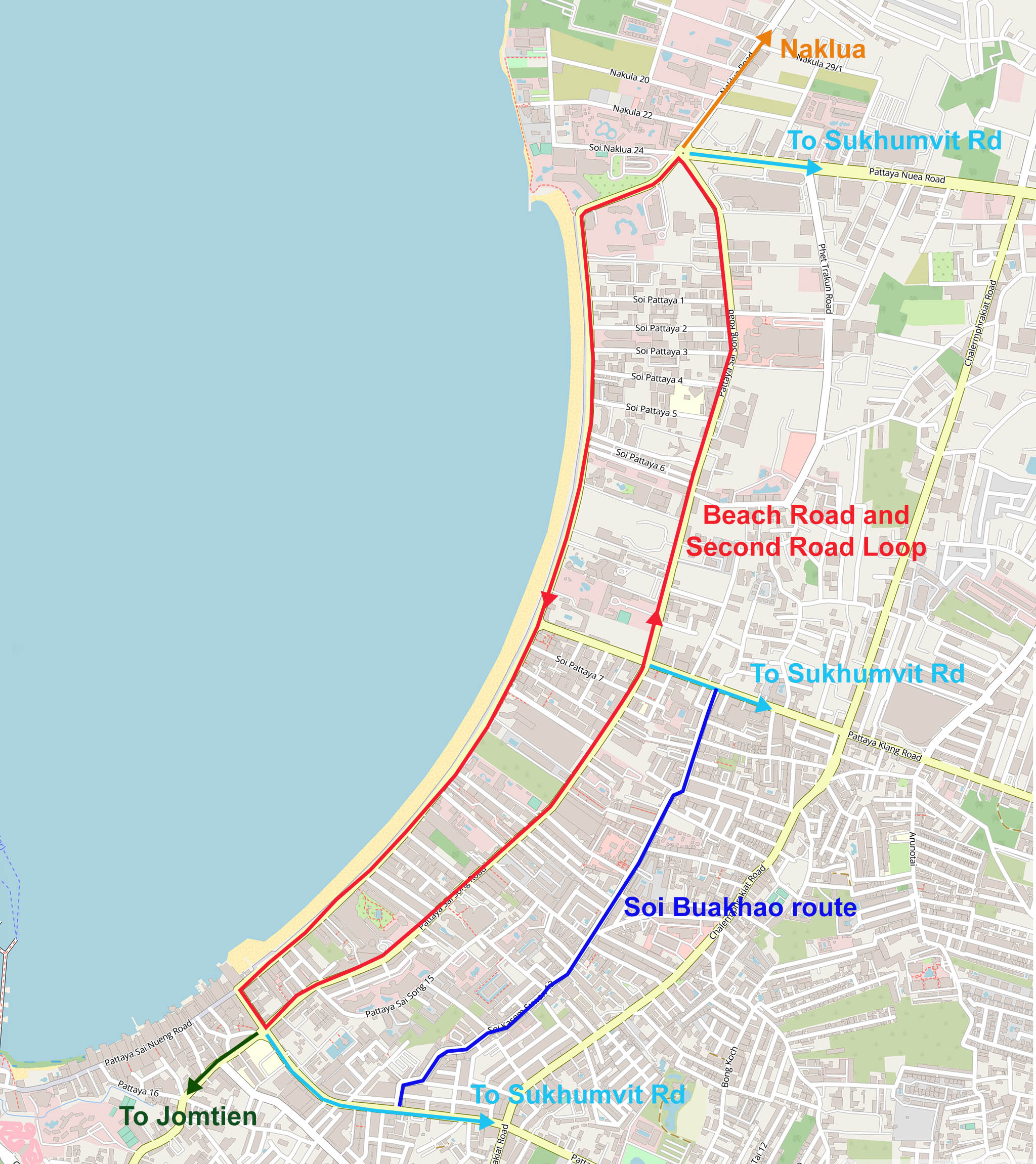
You’ll use this one more than any other. Beach Road is one way heading south and Second Road is one way heading north, so the trucks run a long loop between the two. Wherever you stand on Beach Road, every baht bus going past is heading south towards Walking Street. On Second Road, every one is heading north.
At the bottom of Beach Road the trucks turn left into South Pattaya Road beside the Walking Street entrance, then left again onto Second Road for the run north. At the top end they come back round to Beach Road near the Dolphin Roundabout. Some cut across early on Central Pattaya Road instead of running the full length. If yours turns before you want it to, buzz, get off and catch the next one.
There are places where baht buses will wait for passengers. The most common place is just north of the Second Rd and South Pattaya Rd intersection. They will wait here until they are full or nearly full. It is safe to get on, but don’t talk to the driver. I have also seen them wait a little while on Beach Rd near Soi 6.
Getting home from Walking Street is where most newbies get stung. At closing time, the trucks parked near Walking Street are waiting for charters. Walk the few minutes up South Pattaya Road to the Second Road junction and flag one that’s moving north with people already in it. It’s the same truck at about a tenth of the price. If you’d rather not walk, a Grab or Bolt will still cost you less than the charter, though you might wait a few minutes for it at that hour.
Soi Buakhao
Soi Buakhao runs parallel to Second Road a few blocks inland, from Central Pattaya Road in the north, across South Pattaya Road and down to Thepprasit Road. A lot of long-stay visitors base themselves here because rooms, food and beer all cost less than on the beachfront. It’s also where you’ll find Tree Town, LK Metro, Soi Diana and the Buakhao market.
Unlike the main loop, Buakhao trucks run in both directions. Before you flag one, make sure you’re on the side of the road where the traffic is heading the way you want to go. They don’t come past as often as on the main loop, so allow a few minutes. Otherwise it works the same way: flag a moving one, hop in, buzz and pay at the window.
They wait at each end for enough passengers to board before departing.
Getting to Jomtien
Jomtien is over the hill to the south and the main loop doesn’t go there. The Jomtien trucks wait on South Pattaya Road just south of the Second Road junction and head over Thappraya Road and down to Jomtien Beach Road. It’s 20 Baht for the longer run.
This is the one place where it’s normal to get into a stationary truck, because they wait at the stand until they’ve got enough passengers. The golden rule still applies, so climb into one that already has people in the back and don’t ask the price. If you’re the only one in it and the driver asks where you’re going, he’s sounding you out for a charter.
Coming back, flag a truck in Jomtien that’s heading north towards Thappraya Road. It’ll bring you back over the hill to the same area on South Pattaya Road, where you can pick up the main loop for another 15 Baht.
Newbie Baht Bus Checklist
Do
- Know which direction you’re heading before you step out of the hotel
- Flag down trucks that are already moving, preferably with passengers in the back
- Hop straight in the back without talking to the driver
- Carry 10 Baht coins and 20 Baht notes
- Press the roof buzzer a little before your stop
- Pay at the front passenger window on the kerb side, 15 Baht in town and 20 Baht to Jomtien
- Get off and catch another if the truck leaves the route
- Use Grab or Bolt if you want a private ride, and allow for a short wait
Don’t
- Walk up to a parked, empty truck and ask “How much to…”
- Take the trucks waiting at the end of Walking Street at closing time
- Hand over a 500 or 1,000 Baht note for a 15 Baht ride
- Walk round to the driver’s window on the traffic side
- Argue over 5 Baht late at night
- Assume a truck goes where you want just because the last one did
Do it right a couple of times and you’ll wonder why it ever looked complicated. By the end of your first week you’ll be the one watching a new arrival lean into a parked truck window, knowing exactly what it’s about to cost him.

Last Updated on 18 November 2026 by Rob