Money in Pattaya: currency exchange booths, ATMs, and the 250+ THB fee
Pattaya runs on cash. Card machines have spread through the malls, the bigger restaurants and most hotel front desks, but the places a first-timer actually spends his money still want paper. The beer bar on Soi Buakhao, the baht bus down Second Road, the bar fine, the lady drinks, the massage, the room upstairs and the tip at the end of the night are all paid in cash, and mostly in small notes. This page is about Pattaya money.
Newcomers underestimate this. You’ll go through more cash than you planned and visit the ATM more often than you planned, and if you haven’t thought about how you’re getting that cash, every visit takes a slice you don’t notice. It’s a few hundred Baht here and a poor exchange rate there. Over a two-week trip that adds up to a couple of good nights out that went to a bank instead of to you.
If I was doing my first trip again, this is how I’d handle it.
The ATM Trap and What the Fees Actually Cost
You will never be short of an ATM in Pattaya. They’re outside every 7-Eleven, along every main road and in clusters at the malls. What catches people out is the cost. Every Thai bank charges foreign cards a flat operator fee for each withdrawal, and that comes on top of whatever your bank at home charges you for the privilege.
The Standard Fee in 2026
For years the number was 220 Baht and plenty of older guides still quote it. That’s out of date. As at November 2026, expect to pay 250 Baht per withdrawal on a foreign Visa card and up to 350 Baht on a foreign Mastercard at the major banks. Krungsri and Kasikorn both moved to 250 / 350 in their published fee schedules this year and the others are in the same territory.
Not every machine charges the top figure, but plan as though it will. The fee is shown on the screen before you confirm the withdrawal, so read it before you press anything. If you carry both a Visa and a Mastercard, try the Visa first. That’s 100 Baht back in your pocket every time, which over a fortnight buys a few rounds.
AEON ATMs: Cheaper but Not Worth the Hunt
Ask around on any forum and someone will tell you to use AEON, and they have a point. AEON has traditionally charged foreign cards around 150 Baht, the cheapest operator fee in the country. You can find them in Pattaya, and the Lotus’s on North Pattaya Road is one of the more reliable spots.
The catch is that they’re rare compared to the bank machines on every corner. Saving 100 Baht doesn’t justify a baht bus round trip and an hour of your holiday spent looking for a particular machine. If you’re at Lotus’s anyway, use it, but don’t go out of your way. Check the fee on screen too. I wouldn’t bet on 150 Baht surviving the same round of increases the banks have pushed through.
The Maths: Why Small Withdrawals Hurt
A flat fee punishes small withdrawals. The new bloke withdraws 3,000 Baht because it feels like a sensible amount to carry, does it again the next night and the night after that, and never works out what it’s costing him. The table does the working out for him.
| Withdrawal | 250 Baht Fee (Visa) | 350 Baht Fee (Mastercard) |
|---|---|---|
| 3,000 Baht | 8.3% | 11.7% |
| 10,000 Baht | 2.5% | 3.5% |
| 20,000 Baht | 1.25% | 1.75% |
| 30,000 Baht | 0.83% | 1.17% |
Thai operator fee as a percentage of the withdrawal, November 2026. Your home bank’s charges come on top.
Ten withdrawals of 3,000 Baht cost you 2,500 Baht in fees. One withdrawal of 30,000 Baht costs you 250, for the same cash in hand.
Make fewer, bigger withdrawals. The yellow Krungsri machines (Bank of Ayudhya) are the ones to look for because they allow up to 30,000 Baht per transaction. Most other banks cap you at 20,000 Baht or less, which means paying the fee more often for the same money. Krungsri machines are easy to find along Second Road, Beach Road and around Central. Some Mastercard holders report being capped below 30,000 even at Krungsri, which is another reason to bring a Visa if you have one.
Before you fly, check your home bank’s daily withdrawal limit. A lot of them are set lower than you’d expect and a 30,000 Baht withdrawal can go over, so lift it in your banking app before you leave. Keep in mind that a bigger withdrawal also means more cash on you. It is a good idea to withdraw the cash during the day. Take what you need for the night and leave the rest in the room safe. Pattaya is not a dangerous town, but a man three beers deep with 25,000 Baht in his pocket is making life easy for someone.
Wise and Other Travel Cards
Your everyday card from home is probably the worst card you own for Thailand. Most of the big banks add a foreign transaction fee of around 3% to every purchase and withdrawal, charge their own overseas ATM fee and give you a so-so exchange rate on top. Stack that on a 350 Baht Thai fee and a 3,000 Baht withdrawal is costing you well over 15%.
A multi-currency card like Wise fixes most of that. You load it in your home currency, it converts to Baht at the mid-market rate for a small fee it tells you up front, and you can tap it anywhere that takes cards: the malls, 7-Eleven, Big C, the better restaurants and most hotels (minimum spend limits may apply). Wise gives you a free ATM allowance each month and charges a modest fee beyond that. Revolut works along similar lines.
A travel card saves you on the exchange rate and your home bank’s fees, but it won’t get you out of the Thai operator fee. The machine still charges 250 or 350 Baht no matter whose card goes in, so the big-withdrawal rule still applies.

Dynamic Currency Conversion: Always Choose Baht
Partway through a withdrawal the machine will offer to charge you in your home currency, so you “know exactly what you’re paying”. You do know exactly what you’re paying, and it’s several percent more than it should be. This is Dynamic Currency Conversion, and the rate the machine uses is well below what your own bank or Wise would give you.
Always choose to be charged in Thai Baht. On most machines the button reads “Without Conversion” or “THB”. The same trick turns up on card terminals in hotels and restaurants, where the staff may ask “Thai Baht or Australian Dollar?” The answer is Baht, every time.
Thai ATMs also dispense the cash before they return your card. The new arrival grabs the notes, walks off, and the machine swallows the card a minute later. Getting it back means a trip to the bank branch with your passport, if they can retrieve it at all, so wait for the card.
Exchange Booths vs Airport and Hotel Rip-Offs
If ATMs charge you every time, the obvious alternative is to bring cash from home and change it here. For most people on a first trip this works out cheaper, as long as you change it in the right place.
Airport and Hotel Counters: Emergency Pocket Change Only
The exchange counters in the Suvarnabhumi arrivals hall are there for people who haven’t read anything before landing, and their rates are noticeably worse than in town. Change enough to cover your transfer to Pattaya, a meal and your first night, and do the rest once you arrive.
The exception is the basement level at Suvarnabhumi, down near the Airport Rail Link. The independent changers there offer rates much closer to what you’ll get in the city. If you’ve got ten minutes and the energy after a long flight, it’s worth the escalator ride.
Hotel front desks are worse again. They’ll change money as a convenience to guests and price that convenience accordingly, so leave it for when you’re stuck.
Street Kiosks: Where to Change Your Money
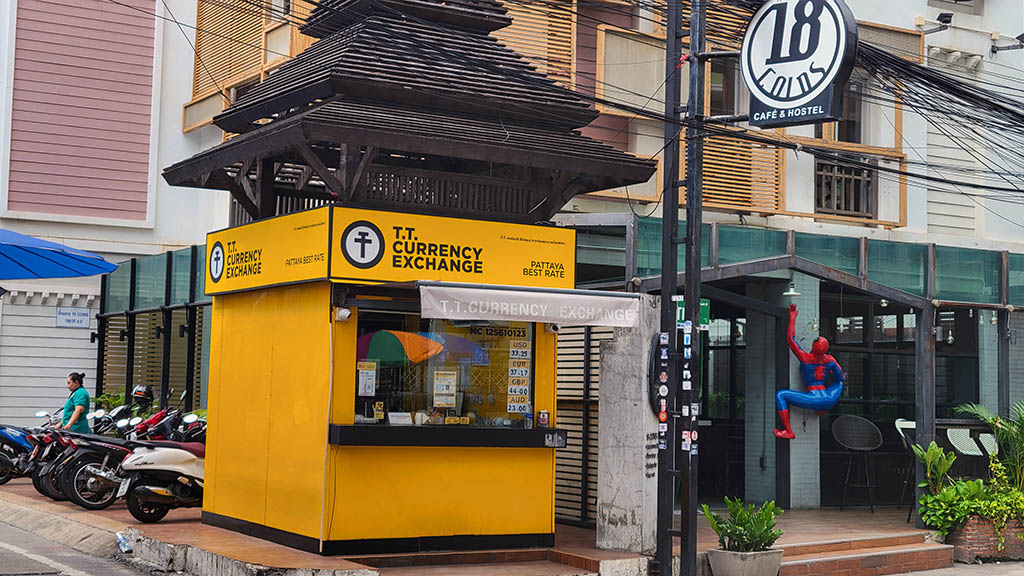
Pattaya is full of street exchange booths and the good ones offer rates close to mid-market. TT Exchange (TT Currency Exchange) is the name I’d point a first-timer towards. Their booths are spread across town on Second Road, Soi Buakhao and Beach Road, so you’re never far from one, and their rates are consistently among the best in Pattaya. Be careful as some other businesses have painted their booths in the same yellow as TT. I have seen that their rates are not as good. Always check the branding and not just the colour.
The bank-run exchange booths (Kasikorn, SCB, Bangkok Bank and Krungsri all have them) are perfectly honest but usually a touch behind the independents. Use one if it’s in front of you, but don’t expect the best rate there.
The board outside each booth shows its buying rate for each currency. Rates can change during the day and vary between booths a few doors apart, so if you’re changing a decent sum, glance at two or three boards before you commit. Unlike an ATM, a booth charges no per-transaction fee, so you lose nothing by changing as you go rather than all at once.
You may get asked to provide ID while exchanging cash. I have found they don’t for small amounts. I would suggest determining the requirements for one that you want to use during your stay and stick with it.
Here are the current exchange rates offered by TT Currency Exchange.
Getting the Best Rate at the Window
- Booths pay their best rate on big notes. US$100 notes get the top rate on the board, US$50s and $20s get less and small notes get noticeably less. The same applies to the Euro. It does not apply to other currencies.
- Torn, written on, stamped or heavily creased notes can be refused or taken at a discount, and older series US dollars sometimes get the same treatment. Get clean notes from your bank before you leave and keep them flat in your wallet.
- Booths may ask to see your passport and copy it. Bring the original, because a photo on your phone won’t do.
- Every booth I’ve used has been straight, but count the Baht in front of the teller before you walk away. A mistake gets fixed in seconds at the window and can’t be fixed at all once you’re on the footpath.
- Thailand requires you to declare foreign currency over US$20,000 or equivalent when you arrive. A first trip shouldn’t come anywhere near that, but now you know.
Breaking Large Notes
Both ATMs and exchange booths will hand you a stack of 1,000 Baht notes, which is awkward in a town where the baht bus costs 15 Baht and a beer costs well under 100. A baht bus driver will not change a 1,000 for a short ride, and you’ll get a look for asking. A quiet beer bar early in the evening may not have the change either.
To sort this out head into a 7-Eleven. Buy a bottle of water with a 1,000 and you’ll walk out with a handful of 100s and 20s. Do it before you head out each night and keep the small notes in a different pocket from the big ones. It also saves you pulling out a thick wad every time you pay for a drink, which is good manners and good sense. I always ensure that I have a good amount of smaller money in my wallet in the early part of the evening.
How I’d Do It
Bring most of your spending money as clean high-denomination notes and change it at a TT Exchange booth as you need it. Carry a Wise card for anything you can pay by card and as a backup. Only use an ATM when the cash runs out, and when you do, find a yellow Krungsri machine, take 30,000 Baht in one go and say no to the conversion. Done that way, your money-handling costs come to a percent or two of the trip. The bloke withdrawing 3,000 Baht a night is paying 10% or more and doesn’t know it. Always keep a backup ATM card in your room.
Summary Checklist: The Golden Rules
- Pattaya’s nightlife runs on cash, so plan for it.
- Thai ATMs charge foreign cards 250 Baht (Visa) to 350 Baht (Mastercard) per withdrawal as at November 2026. Use Visa if you have it.
- Withdraw big and withdraw rarely. Krungsri’s yellow machines allow 30,000 Baht per transaction.
- Use an AEON machine if you’re passing one, but don’t go hunting for it.
- Lift your home bank’s daily limit before you fly.
- Carry a Wise or similar travel card instead of relying on your everyday bank card.
- Arrive with two ATM cards and leave one in the room as a backup.
- Always choose to be charged in Thai Baht, at the ATM and at the card terminal.
- Wait for your card, because Thai ATMs often give you the cash first.
- Change only pocket money at the airport arrivals hall and never at the hotel desk.
- Change cash at street booths like TT Exchange after comparing a couple of boards.
- Bring crisp, high-denomination notes and your original passport.
- Break 1,000 Baht notes at 7-Eleven before you head out.
- Carry what you need for the night and leave the rest in the safe.
For more information about Pattaya, see our Pattaya Newbie Guide.

Last Updated on 3 November 2026 by Rob